
Enter your filter reference.
We will offer you a compatible reference from our range.
Nearly 30 years of filter manufacturing, a 31,000 m² production site and an annual output above 10 million pieces are not just company statistics. For an importer, distributor or equipment maker, they translate into supply you can plan around, from a factory you can deal with directly.
When a model is built many times over on standardized processes, its settings are proven rather than improvised. For you this means batches that look and perform alike from one order to the next, with less rework, fewer complaints and fewer returns on your side.
A library of more than 3,000 models makes you consolidate orders that would otherwise be split between several suppliers. One purchase order can cover a mixed range of car, truck and equipment applications, with simpler logistics and a single contact for quality questions.
Supplying 28 countries means the team is used to different market expectations for packaging, labeling and shipping documents. You don't need to start from zero when they explain how the product should be presented in their market.
Rongsun covers oil filters for passenger cars, commercial trucks and other construction machinery, mainly in spin-on form: pleated media, a perforated steel core, a sealing gasket and flow-control valves sealed inside a steel canister that threads straight onto the engine.
With no trading layer between you and production, questions about materials, valves or tolerances go to the people who build the filter, and approved specifications stay locked for repeat orders. This matters most for OEM buyers, where a specification change that goes unnoticed can compromise an entire shipment.


Our factory operates under a quality management system certified to ISO 9001:2015 (GB/T 19001-2016). As a manufacturer, we organize quality control around 3 stages, so problems are caught where they start instead of at the end of the line:
The spin-on design used across our range puts all of these parts in one replaceable unit. The table below explains what each part does and what to look for when comparing suppliers.

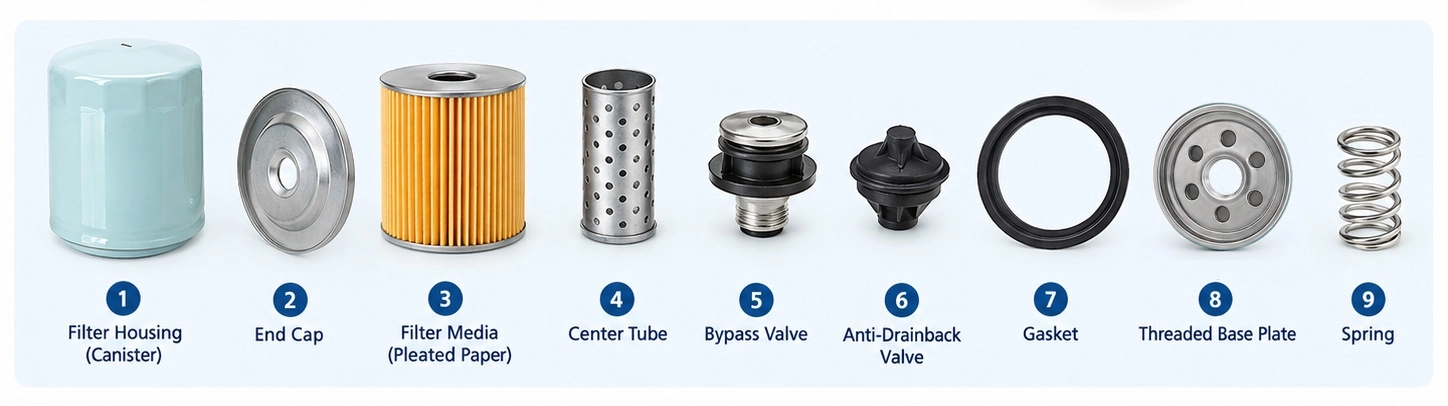
| Component | What it does | What to check when sourcing |
|---|---|---|
| Housing/Steel canister | The outer shell that contains oil pressure and protects the internals from impact and corrosion. | Burst strength, seam quality and paint or coating that resists rust. |
| Filter media | Traps metal wear particles, soot and dust as oil passes through the pleats. Common types are cellulose, synthetic blends and glass microfiber. | Efficiency at a stated micron size, dirt-holding capacity and how evenly the pleats are spaced. |
| Center tube/Center core | A perforated steel core that supports the media so it cannot collapse under oil pressure. | Wall thickness, perforation pattern and clean edges that do not cut the media. |
| End caps | Bond to both ends of the media pack so oil must pass through the media and cannot slip around it. | Bond strength and complete sealing at the pleat ends. |
| Bypass (relief) valve | Opens when differential pressure gets too high, for example with very cold oil or a clogged filter, so the engine is never starved of oil. | Opening pressure that matches the application, and consistent spring performance from batch to batch. |
| Anti-drainback valve (ADBV) | A rubber flap at the inlet that keeps oil in the filter after shutdown, so oil pressure builds faster at the next start. | Material (nitrile or silicone), flexibility at low temperature and a tight seat. |
| Sealing gasket | Seals the filter against the engine block. The most common material is nitrile; silicone or fluoroelastomer is used where heat is higher. | Compound suited to oil type and temperature, correct dimensions and secure seating in the base plate. |
| Base plate | Holds the threaded center outlet and a ring of inlet holes. Thread size and gasket diameter decide whether the filter fits the engine. | Thread accuracy (for example 3/4-16 UNF or M20x1.5), flatness and plate thickness. |
| Pressure spring | Holds the media pack firmly against the base plate so the inlet seal stays closed through vibration. | Consistent spring force and a stable fit inside the canister. |
Schematic only. In the bypass state, part of the oil skips the media and stays unfiltered (red particles reach the outlet). Real valve opening pressures and filtration efficiency depend on the filter model.
Entry. Pressurized oil enters through the ring of inlet holes in the base plate, pushing open the anti-drainback valve.
Filtration. Oil fills the space around the media and flows from the outside of the pleats inward, leaving particles in the media.
Exit. Clean oil collects inside the center tube and leaves through the threaded outlet to the engine oil galleries.
Protection. If the media is blocked or the oil is too thick, the bypass valve opens so the engine keeps receiving oil.
Approved specifications are locked for repeat orders, your engineers deal directly with ours, and the same production base supports every kind of program.
Customers work with us in 3 main ways:
Oil filters made to your drawing and specification, for first-fit, service-parts or branded programs, built and inspected in our own factory.
Replacement filters cross-referenced to OE and major aftermarket part numbers, for distributors and workshop chains.
Your brand on the canister, label and carton, built on proven models from the existing range of 3,000+ models.
With more than 3,000 models, there is a good chance the filter you need is already in the range. We match requests to OE and major aftermarket part numbers. Because filters with identical dimensions can still differ in valve settings and media grade, application data helps us propose the right match instead of a close one.
| Information to send | Why it helps |
|---|---|
| OE or aftermarket part number | The fastest route to an exact or equivalent model. |
| Vehicle or equipment make, model, year and engine | Confirms the application when no part number is available. |
| Thread size and gasket diameter | Decides whether the filter physically fits and seals. |
| Overall height and canister diameter | Ensures clearance and the right amount of media. |
| Photos or a physical sample | Allows a side-by-side comparison when data is incomplete. |
Tell us the models, volumes and branding you have in mind, and our team will come back with matching oil filters, samples and a quotation.
Request a QuoteWe are a manufacturer. The oil filters are produced on our own 31,000 m² site, so OEM specifications, quality and delivery are managed by the team that makes the product.
The range covers passenger cars, trucks, construction machinery and other engine-driven equipment. Send a part number or the equipment model and we will confirm the fit.
Yes. We build to OEM drawings and specifications, and private label supply includes your brand on the canister, label and carton, based on models from the existing range.
Yes. Thread size, canister dimensions, valve configuration, paint color and packaging can be adjusted. A drawing or a sample is the best starting point.
It depends on the model and on how much customization is involved. Send your list of models and we will confirm quantities in the quotation.
Start with a sample order and run your own checks: visual and dimensional inspection, fit on the engine, and bench or field testing under a recognised method such as the ISO 4548 series. Compare efficiency, capacity and pressure-drop results against your current supplier, not only the price.
Use the information listed in the cross-reference section above. The more detail you provide, the faster we can propose a match that fits and performs correctly.


